
Editorial note: This guide replaces a legacy article that presented a single system provider as an automatic route to better hotel operations. Current industry guidance supports a more careful conclusion. Integration matters, but the number of vendors alone does not determine whether a hotel’s technology works well.
A hotel system rarely operates in isolation. A reservation can affect availability, rates, guest records, room status, payments, invoices, and management reports. Restaurant charges may need to reach a guest folio. Housekeeping needs reliable arrival and departure information. Distribution tools must exchange availability, rates, and reservations with the property management system (PMS).
These handoffs can take place within one product suite or between specialist products. Both designs can work. Both can also fail when data ownership, interfaces, permissions, or support duties are unclear. The useful question is therefore not simply, “How many providers do we have?” It is, “Can our chosen systems support each required workflow, including exceptions, with clear responsibility?”
Why hotel-system integration matters
Interoperability is still a live industry issue. In its 2026 review of hotel technology challenges, AHLA’s Hospitality Technology Next Generation group identified a lack of standardization and interoperability across hotel systems. It said heterogeneous systems, proprietary interfaces, and inconsistent integration patterns can make data exchange complex. Its proposed responses include shared data models, API standards, and API-first systems.
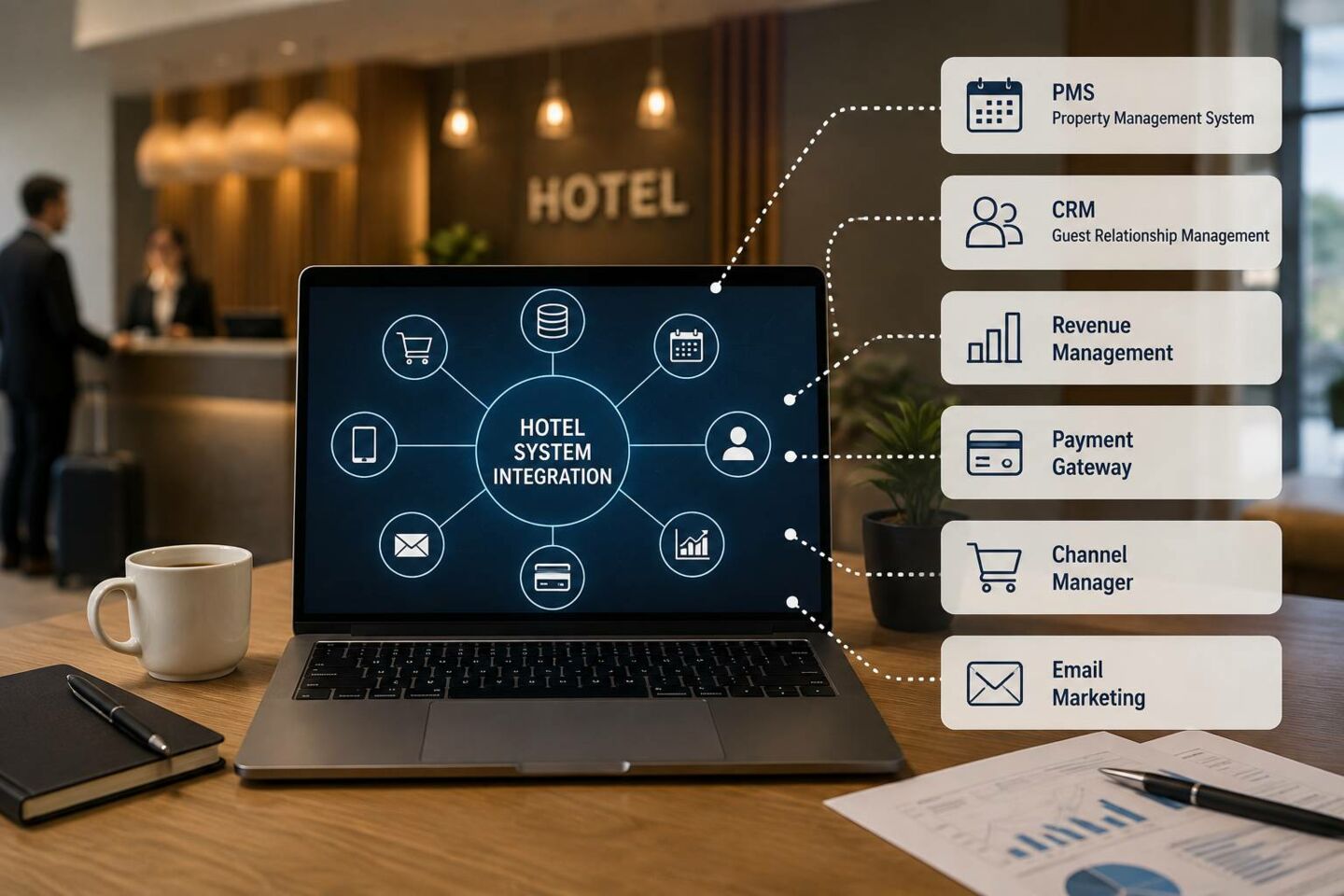
That assessment does not prove that every multi-vendor setup is inefficient. It shows why interfaces deserve the same attention as features. AHLA/HTNG has produced work on property web services, distribution messages, event notifications, point-of-sale interfaces, and back-office data handoffs. OpenTravel also maintains specifications intended to help different travel systems exchange information.
A hotel should map which application creates each record and which applications may update it. One system should be the agreed source for room availability. The team should know where a guest profile is mastered and how duplicates are resolved. The same rule applies to rates, taxes, products, payments, and accounting exports. Without those decisions, even a broad suite can leave staff correcting data by hand.
What an integrated suite can simplify
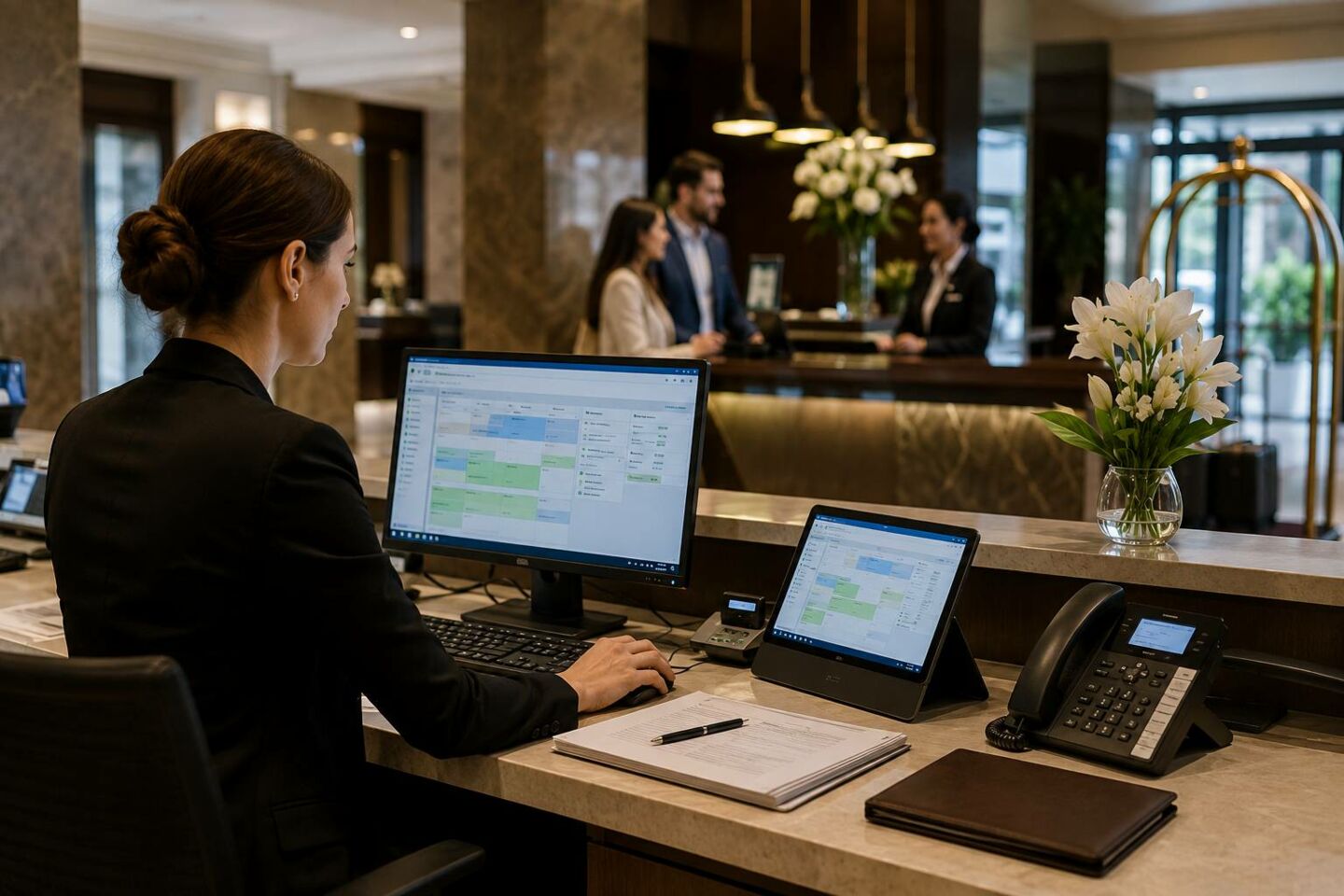
An integrated suite places several operational functions under one commercial and technical umbrella. Depending on the product, it may include a PMS, booking engine, channel management, housekeeping, payments, point of sale, reporting, or guest tools. This approach can reduce the number of contracts and support contacts. It may also give staff a more consistent interface and permission model.
The benefit is strongest when the included modules actually match the hotel’s workflows. A shared product design may reduce the number of external connectors. Releases can be coordinated by one provider, and staff may need fewer separate logins. When a problem crosses modules, there may be one accountable support organization instead of several vendors investigating the boundary.
None of these benefits is automatic. Products sold by one company may still have different technical origins, interfaces, or release cycles. A module may be optional, supplied by a partner, or available only in certain plans or markets. “All in one” is therefore a category description, not evidence of one database, instant updates, uninterrupted service, or complete functional coverage.
Where a specialist stack can be stronger
A hotel may prefer specialist products for revenue management, restaurants, events, guest communication, spa operations, finance, or other needs. This best-of-breed approach lets the property select depth in areas that matter most. It can also make it possible to replace one component without changing the entire operating platform.
Current vendor strategies show that a multi-product ecosystem is not an obsolete model. Mews publishes separate APIs for general PMS connections, point of sale, booking engines, and channel managers, along with a marketplace of external applications. Oracle documents an integration platform for OPERA Cloud customers and partners. These are vendor sources, so they do not prove superior outcomes. They do show that governed connectivity is a mainstream alternative to buying every function from one supplier.
The trade-off is additional coordination. The hotel must understand connector ownership, data mapping, authentication, version changes, monitoring, and support escalation. Subscription charges may not reveal the full cost of implementation and maintenance. Staff may also need to learn several interfaces. These costs should be measured against the value of specialist capability, rather than assumed to be either unacceptable or insignificant.
Follow the data through a hotel day
Reservations and the front desk
Start with a booking created on the hotel website or received through a distribution channel. Test how quickly it appears in the PMS and how inventory changes reach every connected sales channel. Then change the stay dates, room type, rate, occupancy, and cancellation status. Staff should see which system owns each field, whether updates are acknowledged, and how failed messages are handled.
Front-desk testing should include group bookings, split folios, room moves, no-shows, deposits, refunds, and late changes. A polished standard check-in is not enough. Exceptions reveal whether staff can understand the record without switching between several conflicting screens.
Housekeeping and maintenance
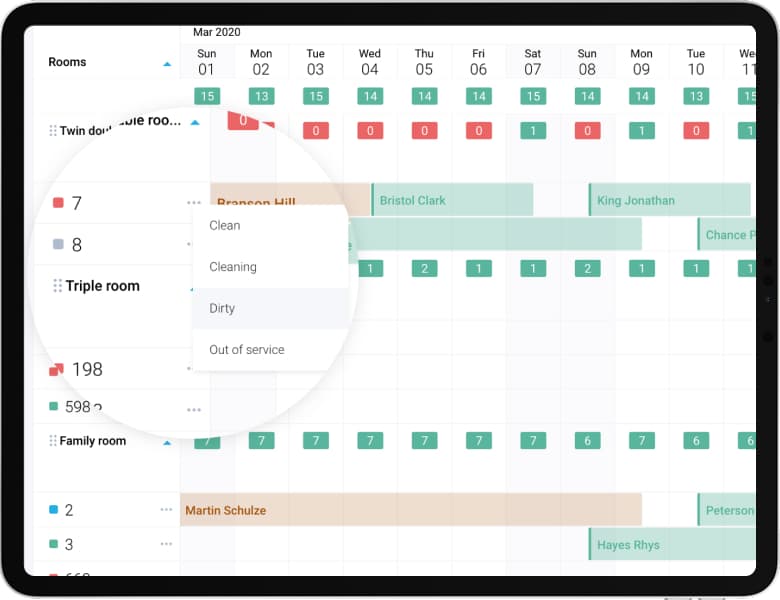
Housekeeping depends on timely room and stay information. Test whether a checkout changes the room status or creates the intended task. Check what happens when a room is inspected, returned for cleaning, marked out of order, or reassigned. A hotel should also confirm what staff can see on mobile devices and what happens when connectivity is interrupted.
Maintenance adds another handoff. A fault may affect whether a room can be sold, but the maintenance record may sit in a separate module. The hotel needs a clear rule for who changes room availability and how that decision reaches reservations and housekeeping.
Food, beverage, payments, and folios
For restaurant and bar operations, verify how the point-of-sale system finds an in-house guest and posts a charge. Test similar names, room moves, shared rooms, reversed items, tips, taxes, and closed folios. The test should show whether a failed posting is visible and who owns the correction. No architecture can guarantee correct charges without configuration, training, access controls, and exception handling.
Payment workflows require equal care. Confirm which provider processes the payment, where tokens or references are stored, and how settlements and refunds are reconciled. Security and accounting duties do not disappear because several functions share one interface.
Back office and reporting
Management and finance teams should trace a sample transaction from source to report or export. They should check taxes, mapping rules, corrections, period closing, user permissions, and audit information. If data moves to external accounting software, the receiving format and failed-export process matter as much as the report screen.
Reports from two tools may use different definitions or update times. Before treating a dashboard as the authoritative result, document the source, calculation, exclusions, and refresh schedule for each important metric.

How to compare the two approaches
Build the decision around required workflows rather than a long feature list. Include routine cases and difficult exceptions. Ask each provider to demonstrate the same scenarios with a realistic configuration and user roles. Record which steps are automatic, which require review, and which rely on another product.
- ● Functional fit: Does each module cover the property’s actual room, food, event, finance, and guest-service processes?
- ● Data ownership: Which system is authoritative for reservations, profiles, availability, rates, payments, and financial records?
- ● Interfaces: Are the needed connections built in, partner-operated, or custom? How are changes, errors, and retries handled?
- ● Operations: What are the documented availability, backup, recovery, maintenance, and offline procedures?
- ● Security: Can roles follow job duties? How are administrators, access reviews, logs, and departing staff handled?
- ● Support: Who owns an incident that crosses systems? What evidence must the hotel collect, and what response terms apply?
- ● Change: How are interface versions, product releases, test environments, and deprecations managed?
- ● Cost: Include setup, migration, connectors, training, support, hardware, payment charges, custom work, and internal administration.
- ● Exit: In what format can the hotel retrieve data and documents? How long will access remain, and what migration help is available?
A proof of concept should use representative data without exposing real guest information unnecessarily. The team should define acceptance criteria before the demonstration. It should also name an owner for each unresolved issue. This produces evidence that can be compared across suppliers.
Current HotelFriend product context
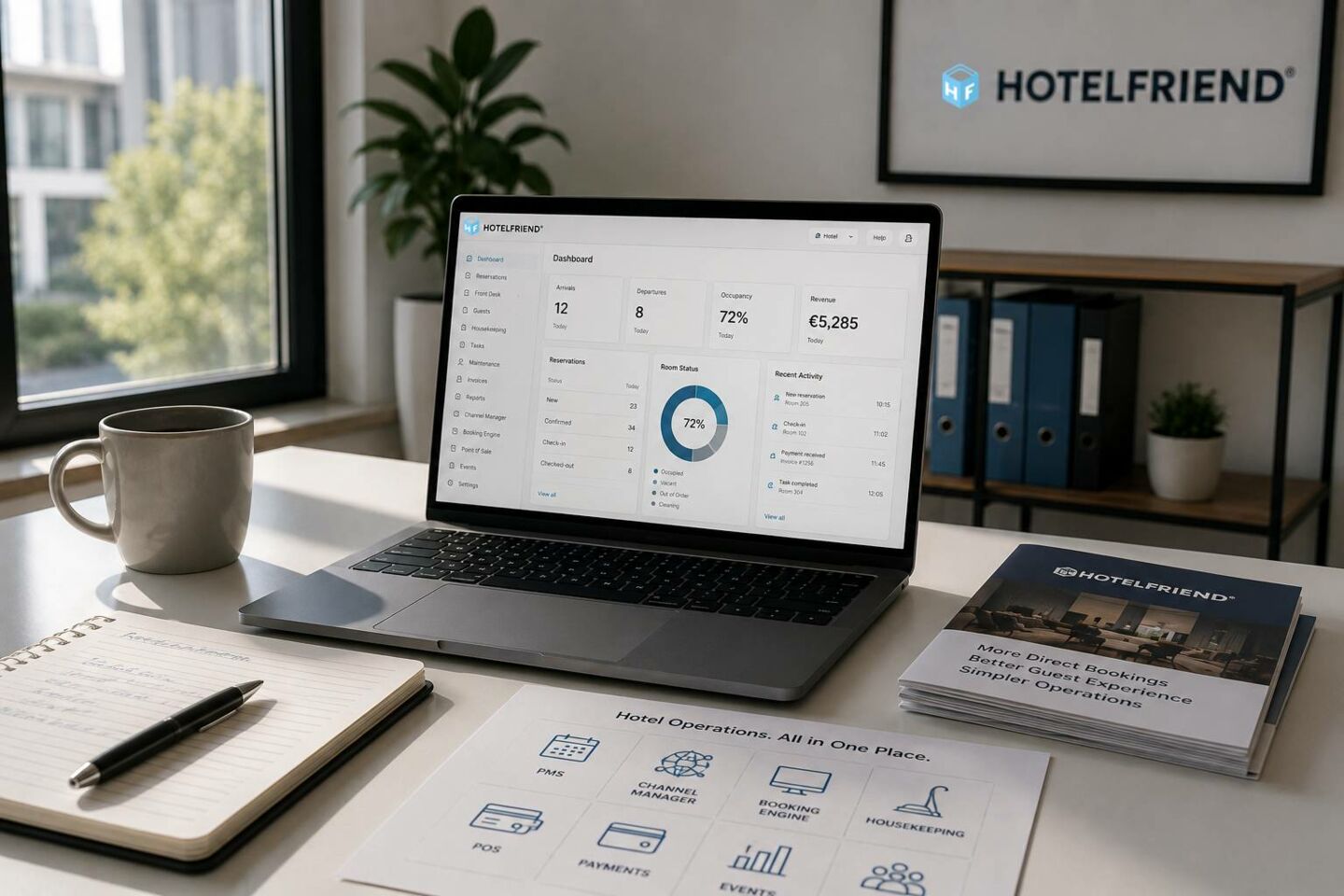
HotelFriend currently presents its offering as a cloud-based hotel platform. Its official product page lists PMS functions for reservations and guest or company records. It also describes housekeeping, reports, payments and invoicing, task and maintenance functions, an integrated Channel Manager, a Booking Engine, guest-facing tools, point-of-sale functions, and event-related products.
HotelFriend also states that its PMS supports third-party integrations. These statements describe the current public product offer; they are first-party claims, not independent proof that every module is included in every plan or suits every property. A prospective customer should confirm the exact package, country, configuration, connector, and contract that apply to its project.
The public pages do not, by themselves, establish that HotelFriend gives every customer one database, eliminates manual work, prevents errors, saves a fixed number of hours, increases revenue, or guarantees a business result. Those claims are not made in this guide. Hotels should request technical and contractual evidence for availability, support, integration coverage, data export, migration, and recovery before relying on them in a selection decision.
A practical conclusion
A capable integrated platform can reduce interfaces and simplify ownership when its modules fit the hotel. A specialist stack can offer deeper tools and flexibility when its connections are well designed and governed. Neither option is inherently seamless, stable, cheaper, or more productive.
The most reliable choice is the one that passes the hotel’s workflow tests and makes responsibilities explicit. Review data ownership, exceptions, security, support, total cost, and exit terms. Treat demonstrations and vendor descriptions as starting points, then verify the exact operating conditions in the product and contract.